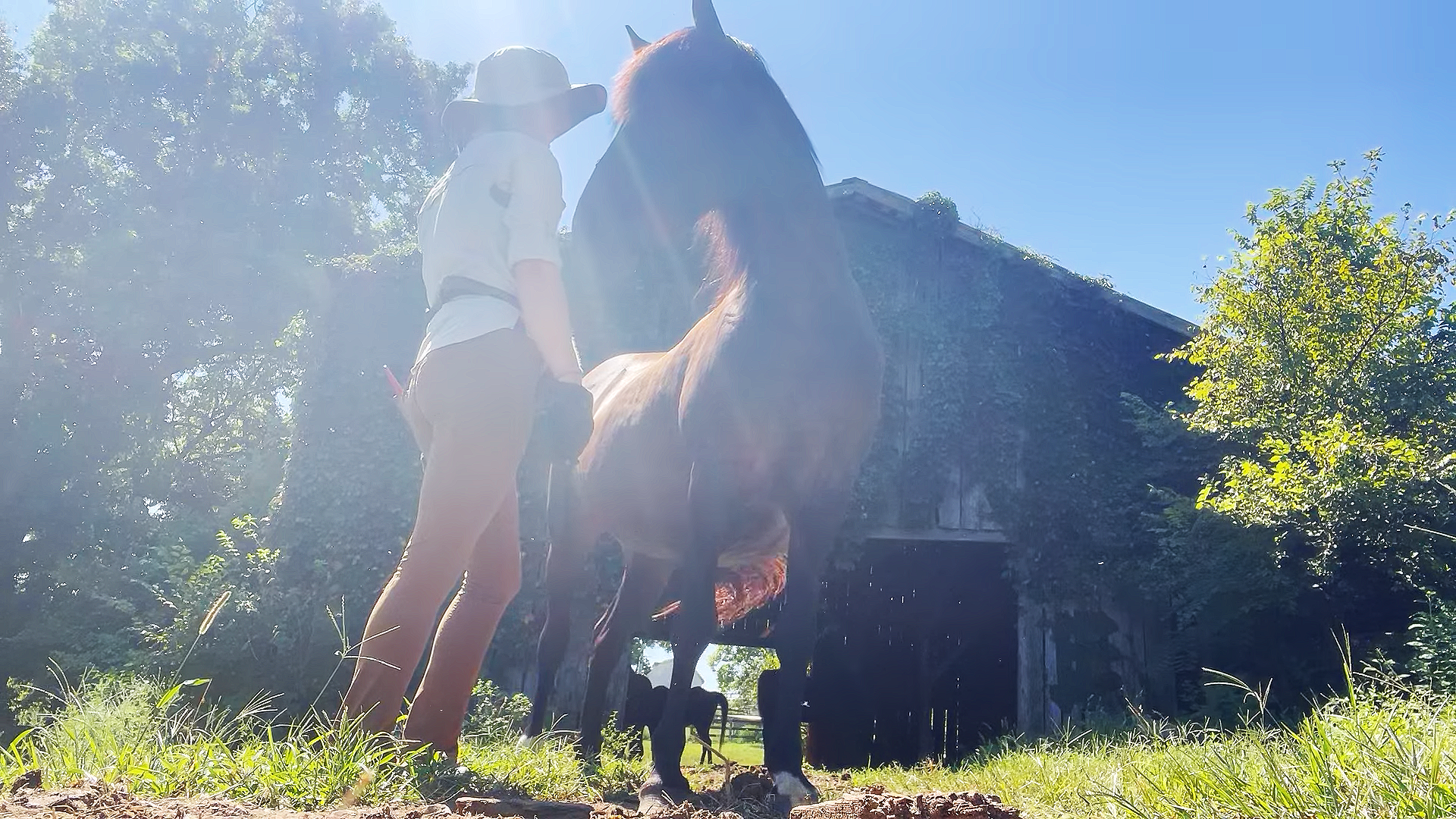
Last week, I went out to trim and train a beautiful mustang mare who has encountered significant trauma in relationship with another trainer, leaving her untouchable for years before she met me. My job was to find a way to connect with her so she could feel safe having her feet trimmed, and eventually to be able to get basic dental and veterinary care too. She lives in a huge field with a herd of other horses, and at first I couldn’t get anywhere near her. Through very slow approach-and-retreat as well as clicker training, I have become able to trim her front feet and touch almost every part of her. It’s all been completely at liberty through attunement and positive reinforcement.
These days when I go out to work with her, I don’t feel so much like I’m working with this traumatized wild horse.
My focus has turned to helping her get the most balanced and healthy feet and body she can possibly have.
I’ve been studying hoof trimming more seriously lately, and am on my way to becoming certified in Ida Hammer’s Whole Horse Hoof Care program. So when I look at her these days, I’ve been noticing more about the work I have to do with her feet and her posture than I am purely focused on the connection with her and how she feels about everything I’m doing.
I used to not allow myself to look too hard at the imbalances in her teeth, jaw, hips, and spine, because what good would it have done to fixated on her vulnerabilities with no ability to heal them?
But things have shifted, and I can trim her like a normal horse on the front feet, if not better because there’s no halter or ropes, and no one there to hold her. We don’t need it. I notice when she needs to put her foot down or take a break to do some simple targeting or have her itchies scratched.
But my intention shifted to fixing her feet and her body.
This is where I went wrong.
I began to notice increased hesitation to offer me her feet. She wasn’t fearful like she was when I met her, but just unsure how much she wanted to participate. I began feeling the pressure that I had to maintain her feet as well as possible, because now she’s shown me that I could. It’s a pressure I put on myself, not one from my client or anyone else. The mare gave me a taste of what was possible and I began to take it for granted.
She very clearly told me that she wanted me to stop fixating on fixing her hooves and her body. She missed the days when everything was built on her feeling safe to express and tell me how she felt about everything, and that she would guide each next step. I took that away from her when I felt like I could trim just her, and she did indeed stay calm at liberty, but I was assigning the next steps to her– of bringing her toes back and her heels level and bars and frogs cleaned up…. My focus was in the wrong place.
She was grieving the bond we had when I didn’t necessarily expect it would be possible to trim her or even touch her.
When every step towards each other felt like a blessing.
The way I listened with my whole heart and never told her what I needed her to do, just asked what she wanted me to do. She missed that.
She was asking me to accept what was without trying to change it.
I put my nippers and rasp down. I took off my gloves and chaps. I walked away and practiced Qigong. I refilled my treat pouch and approached her differently. I told her I was ok with not getting her feet perfect that day– I wanted to improve them, but I didn’t want to lose the connection we had in the process. And again, this wasn’t an issue of pushing through stress. She wasn’t afraid, and her communications about which foot to trim and how long and when weren’t being ignored, but my focus and intention had shifted. I was more focused on fixing than I was just being with her, and in doing that, we were drifting apart.
But when I laid down my tools that day and approached with a new energy and intention, she came back, even out of the run in with all her friends, which used to not happen very easily.
I turned my focus to finding her itchy spots, to noticing how she felt under my hand and in my presence without trying to change it. Back to softening at subtle signs of tension. Returning back to where we started. It was the first time I was able to touch her face. It was the safest she felt in her pelvis under my hands. It was real progress towards trimming her hind feet and haltering her and sedating her for a dental.
Because I let go of the expectations that I had allowed to take root.
Because I allowed myself to accept her and her body and her feet exactly as they were and resisted the urge to try to change them in that moment, because it really wasn’t what mattered most then.
Mustangs are incredible at teaching this lesson. Down the road with another mustang, I had another tough lesson. I was preparing this pony to start under saddle, and he’d developed quite a repertoire– turn on the forehand, turn on the haunches, shoulder in, lateral bending from one or 2 reins, beginnings of lunging, self bridling, and placing a saddle on his back. I’m only out there once a week and I began to put pressure on myself to do enough each session to try to make my client really feel like we were making a ton of progress. I was jamming too many things into each session, and the pony was beginning to tap out. He was losing confidence in himself.
He was becoming hesitant to go forward because it wasn’t all about him or guided solely by his conversation anymore, it was about my people-pleasing and putting expectations and goals onto him that he didn’t choose.
We weren’t moving too fast and he wasn’t afraid. But he was beginning to feel exhausted from the work and wasn’t getting the processing time to really experience the releases. I was getting greedy.
I needed to accept him exactly as he was and not try to change him.
That’s where we started, and he blossomed into this light willing pony with so many skills, but I stunted him by getting too focused on where we were going and not present enough to really allow him to enjoy where we were.
The lesson was presented to me again and I’m trying my hardest to learn it this time.
One of the horses at my farm has a fear of injections. Spring vaccine season has rolled around and we had been feeling more pressure to double down on helping him feel safe about getting injections and focus almost solely on this in our sessions.
But once again, this became a situation where my focus shifted towards wanting to change him– in the kindest way, wanting to turn his fear into a sense of safety and acceptance.
But that feeling of wanting to fix him, to change him, to train him created a disconnect where our progress plateaued. While we can have clear goals to move toward in training horses, it’s so incredibly important that we set those aside while we work, and just work with what the horse is telling us in that moment.
The pressure of timelines, agendas, and expectations create resistance, tension, and disconnect.
Your intentions can be in the kindest, most loving place, but that doesn’t negate the value of accepting what is without trying to change it.
Often when we stop trying to fix things, they fix themselves.
It’s paradoxical, and trying to learn this lesson can feel like cycle of being amazed at what all is possible, and then becoming attached to progress, and then plateauing, and relearning how to accept what is without trying to change it, and then once again marveling at what all is possible and feeling the progress made without trying so hard to get it.
At a hoof trimming clinic I participated in recently, a fellow student asked me which quadrant in operant conditioning I used when teaching horses relationship to contact. She liked to organize it that way in her mind, and understood that while I might not necessarily be fixated on an outcome, but that I was inevitably using one of the four quadrants. Technically speaking, she’s right. And I often remind my students that every interaction with your horse teaches them something, which is why we need to approach with intention. But in processing her question, I felt a huge aversion to categorizing this work in that way and became defensive. I surprised myself at the emotions that welled up and my inability to categorize it.
When I explained my process, the ladies I was in conversation with said I’m using negative reinforcement. It bothered me to think of the connection work in that way, even though technically speaking they were right. It just didn’t feel like it fit.
Reflecting on it now, I think the aversion I felt came from knowing that an important part of that process of teaching relationship to contact is accepting what is without trying to change it.
In my demonstration at a clinic earlier this spring, the horse welled up with anger when he felt my hands on the reins. I committed to staying neutral and moving wherever he moved, never increasing the contact into pressure, never pulling or restricting, but also being fluid enough to staying with him, holding hands.
He didn’t believe me when I told him the contact was for connection, not control.
His experience had been that contact is a set length of rein that he would lean on or a progressively shortening rein, and shortening neck, and shrinking sense of freedom… I stayed with him as he bit at me for about 45 minutes, staying soft, keeping my heart open, never pulling.
He had a huge shift that day and rewired so many associations.
I know I could have never done it if I were thinking in my mind that I needed to change HIS mindset. To get rid of the anger, to get him to relax and soften.
The only way it was possible was by being open to whatever he had to say without trying to prove him wrong, just by staying steady and grounded and showing him with my heart through my hands and reins that I wasn’t there to try to control him.
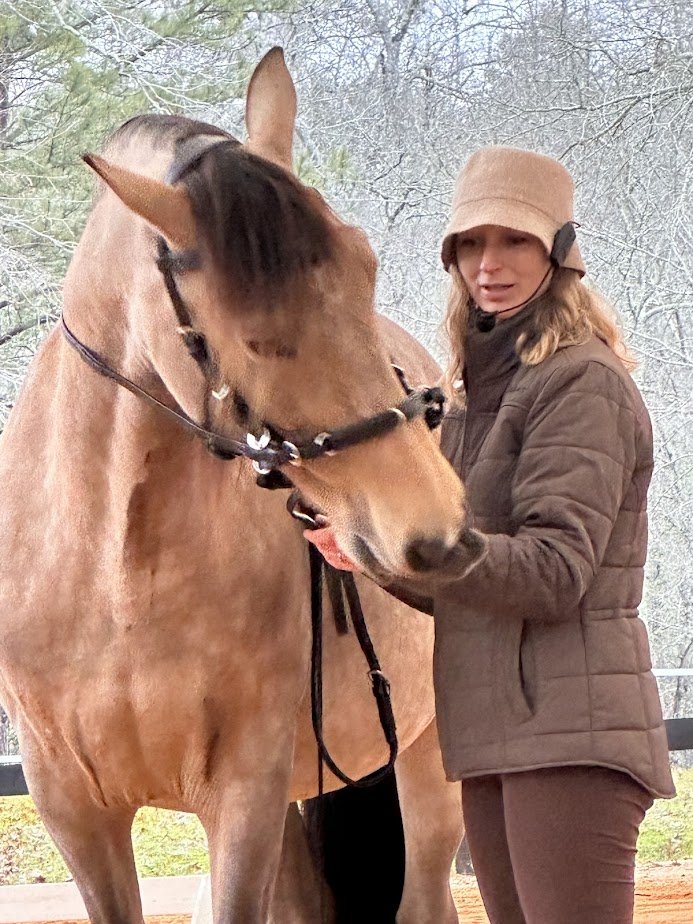
Stormy Biting Me
I kept my heart open to what he had to say and I detached myself from any outcome. I radically accepted that maybe I would look like an idiot creating an aggressive horse in front of a crowd of people.
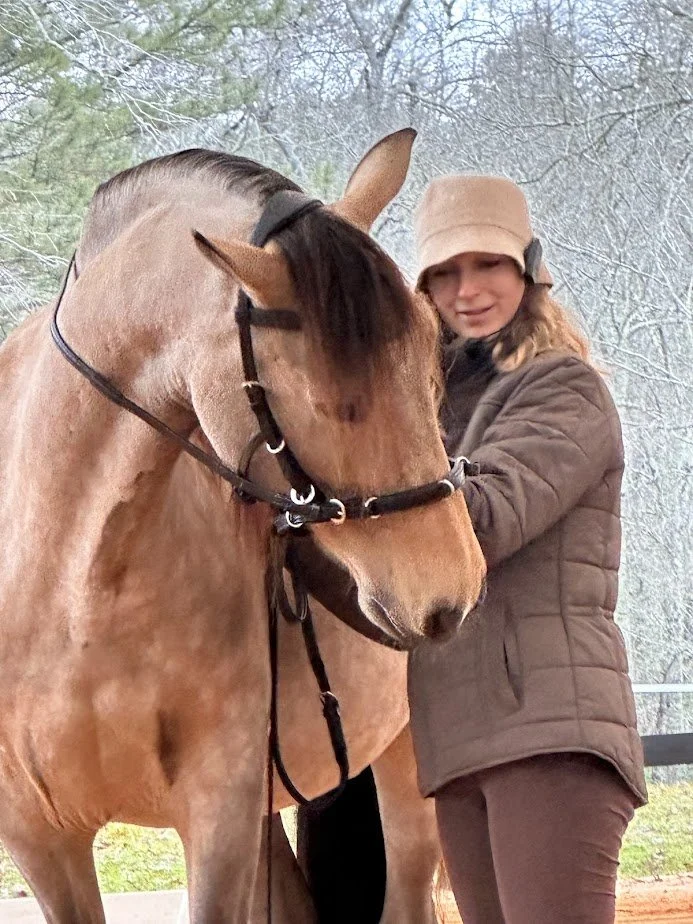
Stormy Questioning Me
He was wondering when I was going to brace or push his head away or tighten the reins. He didn’t understand why or how I was staying the same, and what the contact meant if not control.
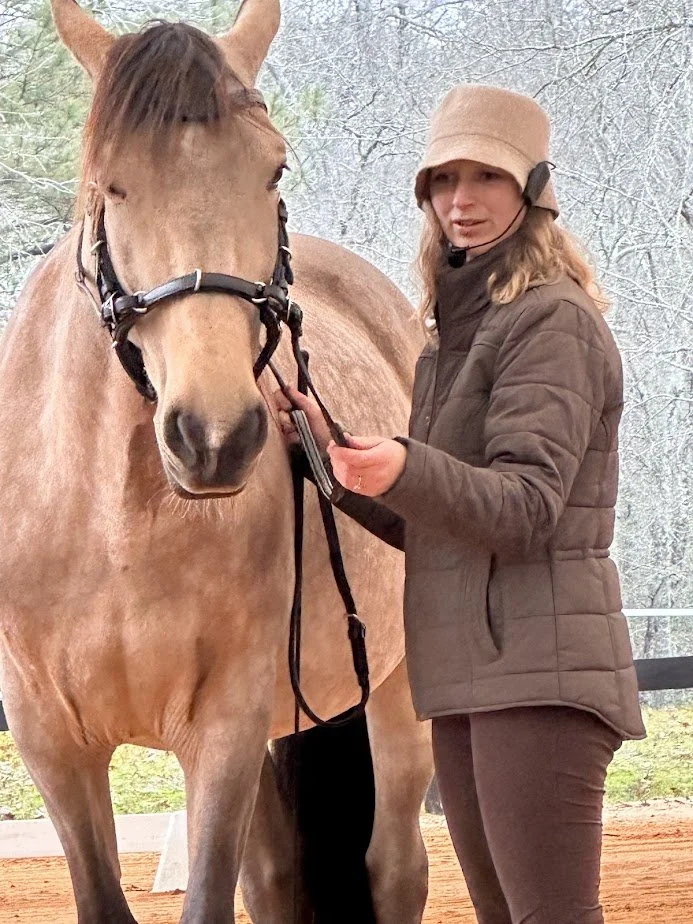
Stormy Softening
He begins to consider the possibility that the hand could have a different meaning than what he’d been taught. He began to open his heart and listen.
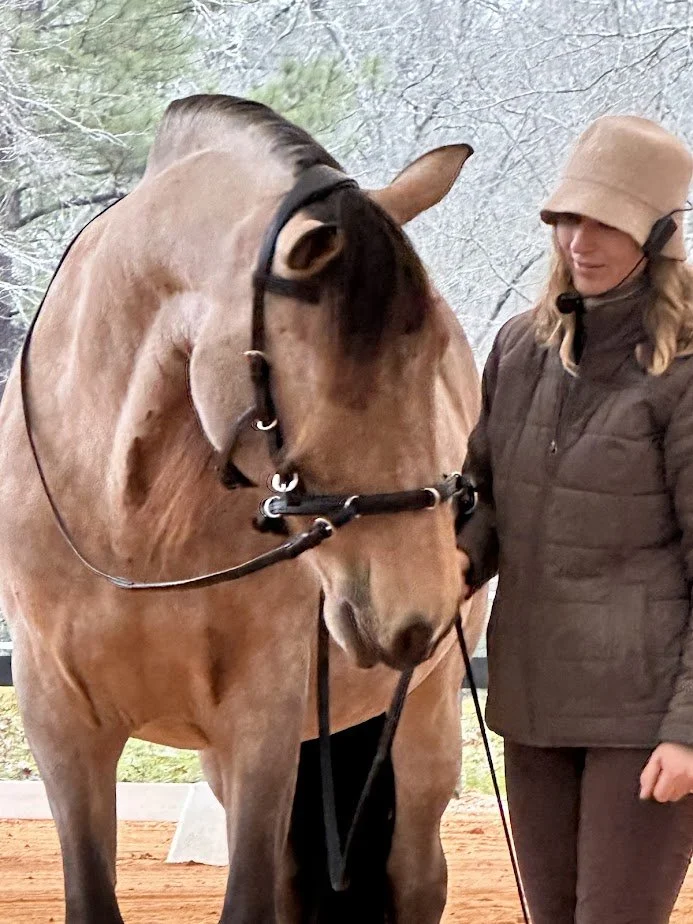
Stormy Reprocessing
I gave him space to rewire his nervous system with the new information that contact could mean connection. And in the way tend to think about it, you cannot train connection— you only create circumstances for it to take root and grow and blossom. And from that foundation, I can teach.
The mindset with which we approach what we’re doing has a massive impact on the outcome. Over intellectualizing stunts progress, and it stunts connection.
What the horses crave is not perfection.
It’s not doubling down on the details.
It’s just love.
It’s just being and anything else is a cherry on top, but when we focus only on the cherries, we lose the health of the tree.
In this particular clinic demonstration, I really feel that I was able to stay so neutral, open, and loving because I’d practiced Qigong just before. Anna Lewis, my teacher, helped me to open my heart and ground me to where I felt safe no matter what happened to or around me. I felt deeply rooted into the earth, with the sense of my own energy and stability in my belly, and a sense of ease where I was able to observe myself, my environment, and the horse in my hand without judgement or fear.
One of the most powerful and simple Qigong practices are those in stillness. Standing tree meditation and standing like a post are wonderful for gathering Qi to you, and reducing chronic inflammation. When you become very still, your body gets your attention in areas of stagnation, inflammation, and dysfunction. Sometimes it's pain, sometimes other sensations.
The practice is to notice and accept what shows up without trying to change it.
Sometimes my body lights up like a Christmas tree with shooting pains, aches, burning sensations. Other times I feel tingling, flows of energy circling around my palms, sometimes I feel the energy from the earth charging me and grounding me. No matter what I feel, the practice is to not become attached or averse to the sensations– just to notice them and become curious about them, without attaching a story to them. Anna Lewis told me that medical Qigong masters traditionally stay in stillness practices for up to 4 hours, gathering energy to them. Imagine all of the sensations that may come up in that time of being completely still, and being able to stay mindful, present, without any intention to do anything with them but simply feel and be still.
The main practice that got me out of frequent, severe flares of chronic pain is known as pain reprocessing. This is a form of therapy, although I became a student of it and learned the concepts and the practices, and became my own therapist. Intense bouts of pain, weakness, fatigue, ophthalmic problems, and burning/blistering of my toes led me to the diagnosis of fibromyalgia, a form of central sensitization.
Basically, my central nervous system becomes hypersensitive and processes a broad range of stimuli through a lens of danger, producing the sensation of pain and physical features like alarm bells to try to alert me to find safety.
It’s an overactive sympathetic nervous system, although I can experience symptoms while not feeling mentally/emotionally as if I’m in fight/flight, until the pain comes on. The pain can become a secondary trigger of anxiety for not being able to do my work, guilt for not pulling my weight or spending enough time with friends and family, and sadness for not being able to use the time I am forced to make for myself to work with my horse.
Pain reprocessing is a practice of training the central nervous system to perceive sensations through a lens of safety, shifting the narrative formed in the brain, and the pattern of symptoms.
A starting point is using the breath and mindfulness techniques to bring you into your body in a relaxed state and becoming innocently curious about anything that might come up. Even if a severe pain arises, the practice involves focusing on it. What DOES it feel like? Where exactly is it? Is it moving? Is it changing?
When you can curiously observe the inner choreography of the body without allowing fear to take over, the practice of asking the questions begins to change the answers.
Focusing in on the pain without even labeling it as “pain” or something to be afraid of or to try to change creates an environment within the central nervous system where the sensation is no longer needed.
The body feels safe, the alarm bells stop ringing, and the pain melts away.
This is essentially what I am doing when I rehabilitate a horse— once they’re able to feel safe, the physical pain and dysfunction become manageable enough to be able to train new skills to build new neuromuscular pathways. This is what healing looks like.
It’s incredibly challenging to allow yourself to feel everything the body feels without trying to change it.
We’ve been trained by our culture to always look to fix things, and to fix things we’re taught to figure out what the problem is and analyze it.
When it comes to pain, this can put you in a loop of fearing the information coming from the body, which primes the nervous system to produce louder and more frequent pain signals because the body doesn’t feel safe, and the nervous system’s only job is to keep us alive. When we can live in harmony with the sensations in our body, the experience shifts dramatically. It’s simple but not easy at all.
I am revisiting this lesson once more, as my body starts to fall into patterns of fatigue, pain, and weakness. I find myself trying everything I can to make the pain go away– physical therapy, acupuncture, myofacial release, craniosacral therapy, Qigong, PEMF, rest, Feldenkrais, special footwear, kinesiology tape, liniments, and much more. And there’s absolutely NOTHING wrong with any of these modalities, but I’m learning yet again that
if I approach them through the lens of trying to “fix” my body or just make the pain go away, I approach them from the motivation of fear.
And fear is what charges up the pain and keeps me in this cycle.
I’m working on shifting the narrative to instead move towards wholeness and healing. I’m seeking what’s nourishing and offering my body things it can take pleasure in, and broadening my awareness to all the sensations without judgement about what they are and what they mean.
In the past year, I’ve been presented with numerous instances of relational pain and grief as well. Friends and family that are not able to be what or who I have always felt they were supposed to be, or what I really wanted. While there have been many opportunities to set boundaries and learn to communicate more clearly with others, there’s also been a need for radical acceptance of who others really are, as disappointing and painful as it may be.
Accepting what is, without trying to change it.
I can’t change others, but I can change my relationships to them and find change within myself to be able to find harmony with those who are challenging to harmonize with. Sometimes it’s accepting the loss and grief of relationships. This same idea of moving towards wholeness, towards healing through openness and acceptance.
It’s a lesson showing up over and over again, beckoning me to learn it, so I’m writing it down.
I’m not writing this to necessarily teach anyone else or to prove any kind of point. I don’t want to be anyone’s guru. I don’t want to claim to even know this— because I’ve been offered this lesson so many times and apparently I haven’t learned it. And that’s not me beating myself up, I’m just being honest.
I’m writing this to try to integrate the lesson this time, and I’m sharing it because maybe that’ll help me too, and maybe it’ll even help someone else.
But I don’t claim to have the answers or to have mastered anything. I wonder if I’ll ever be totally comfortable with that.
I wonder if I can accept that without trying to change it.
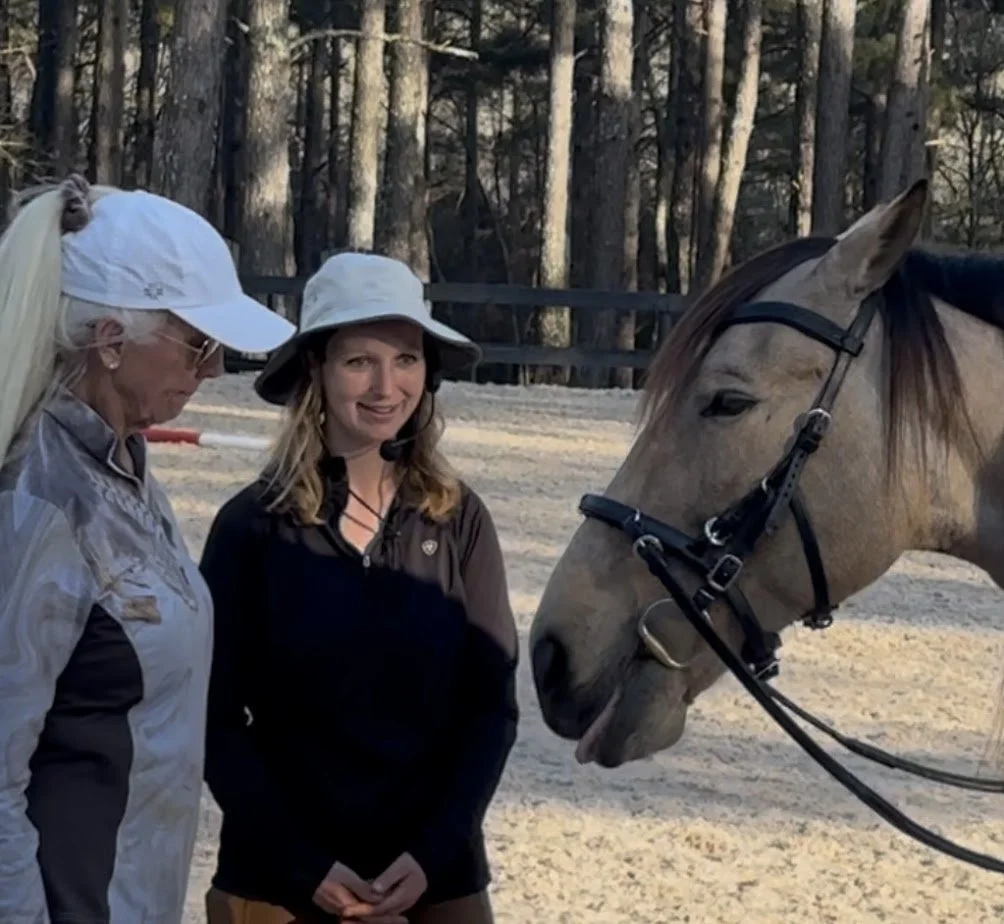
Stormy with his new relationship to contact.
Now we can rebuild his understanding of the reins and the bit.